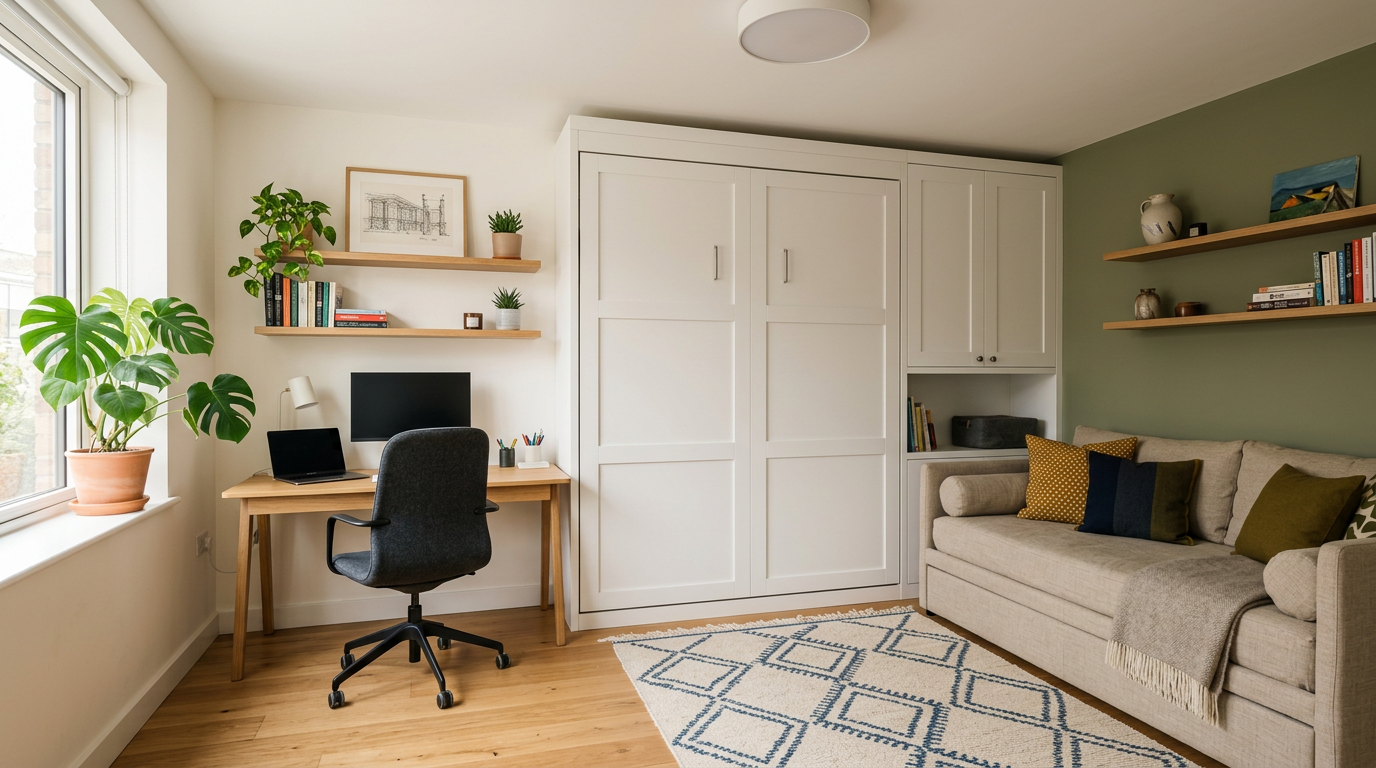
When Your Office Shares the Room
Most people don’t have the luxury of a dedicated office. Your workspace might share a bedroom, living room, dining room, or hallway. The challenge is creating a functional office that doesn’t dominate the room’s primary purpose — and can be mentally “closed” at the end of the workday.
Office in the Bedroom
Positioning
Place the desk so it’s not the first thing you see from bed. Ideally, position it behind you when lying down or in a corner that’s out of the bed’s sightline. The bedroom’s primary identity as a sleep space must be preserved.
Visual Separation
A bookshelf between the desk and bed, a curtain on a ceiling track, or even a large plant creates a psychological divider. You’re creating two rooms within one.
Closing Up
At the end of the workday, clear your desk, turn off the desk lamp, and draw a curtain if you have one. This ritual signals to your brain that the bedroom is now a restful retreat, not a workplace.
Office in the Living Room
Choose the Right Corner
The corner furthest from the TV and main seating area works best. You want to be able to work without being drawn into household activities, and your family should be able to relax without feeling like they’re in your office.
Furniture That Fits
A desk that matches the living room’s aesthetic looks intentional rather than intrusive. A mid-century desk in a mid-century living room, an industrial desk in a loft-style space. The office furniture should follow the living room’s design language.
Secretary Desks and Armoires
A secretary desk with a fold-up front or an armoire converted into a workspace hides the entire office behind closed doors. When the doors are shut, it’s furniture. When open, it’s a fully equipped workspace.
Office in the Dining Room
The Dining Table Approach
If you work from the dining table, invest in a beautiful desk caddy or tote that holds your daily essentials. At the end of the workday, everything goes into the caddy and the table returns to dining duty.
Console Desk Along a Wall
A slim console against the dining room wall serves as a desk during work hours. Keep it styled as dining room furniture when not in use — a vase, a few books, a lamp. During work, swap in your laptop and supplies.
Shared Home Office for Couples
Back-to-Back Desks
Two desks facing opposite directions create individual workspaces in a shared room. Each person faces their own wall, reducing visual distraction.
L-Shaped Configuration
A large L-shaped desk or two desks forming an L gives both people a defined workspace while sharing the room efficiently.
Acoustic Boundaries
Noise-canceling headphones are essential. If one person takes calls, consider scheduling call-heavy blocks at different times or positioning the caller further from the other desk.
Universal Dual-Purpose Tips
Matching Aesthetics
Office furniture that matches the room’s existing style disappears visually. A mismatched office setup in a living room screams “workspace” — a coordinated one blends in.
Storage That Closes
Open shelves of office supplies next to a living room sofa look wrong. Closed cabinets, drawers, and boxes keep work materials hidden when you’re off the clock.
Good Lighting for Both Purposes
A desk lamp provides task lighting for work without illuminating the whole room. This means others can relax in dimmer ambient light while you work under focused light, or vice versa. See our home office lighting guide.
The Power-Down Ritual
Regardless of room configuration, develop a daily closing ritual. Tidy the desk, close the laptop, switch off the lamp. This psychological transition protects both your productivity and your rest.